
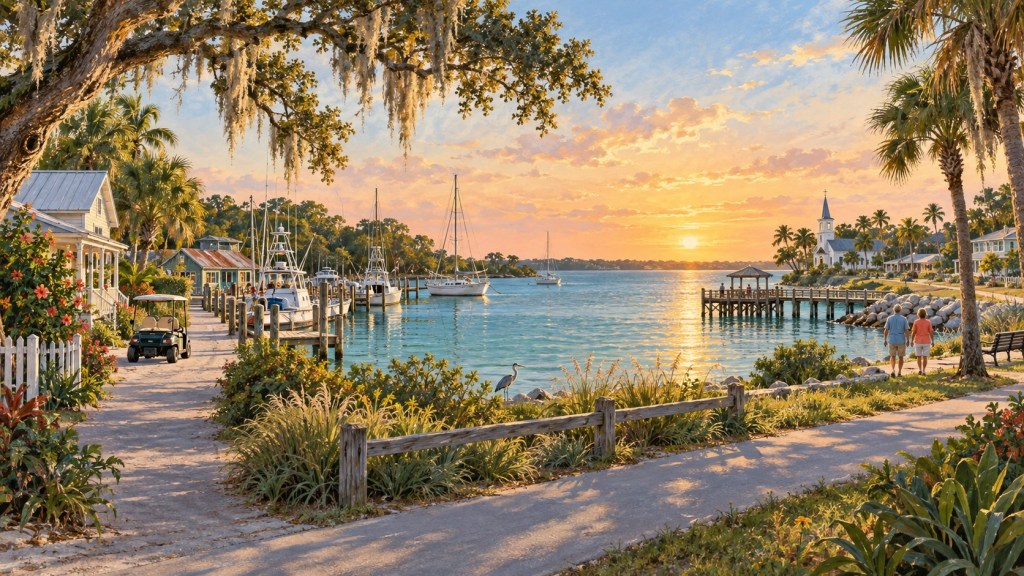
Ozona and Crystal Beach may share a Palm Harbor mailing address, but each has a personality all its own
Drive along Alternate U.S. 19 through northern Pinellas County and it is easy to think you know the communities you are passing. There is Dunedin to the south, Tarpon Springs to the north and Palm Harbor in between.
But turn west off the highway and you may discover something unexpected: two little waterfront villages that seem to occupy a world of their own.
Ozona and Crystal Beach are not incorporated towns. Technically, they are part of the unincorporated Palm Harbor area, which means they are governed by Pinellas County rather than by a local mayor and town council. Their residents generally use Palm Harbor mailing addresses.
But neither feels like just another Palm Harbor neighborhood. Each began as a separate settlement. Each has more than a century of history, a close relationship with the water, and residents who have worked to preserve its individual character.
And each offers a version of Florida that can be surprisingly difficult to find amid the subdivisions, shopping centers and six-lane highways of the modern Tampa Bay region.
These are places of old cottages, spreading trees, bicycles, golf carts and sunsets over St. Joseph Sound. They are close to everything in North Pinellas County, yet a little removed from the pace of everything around them.
Ozona: An eclectic village by the water
Ozona lies west of Alternate 19, just south of downtown Palm Harbor and north of Dunedin. It is bordered by Sutherland Bayou on the north, St. Joseph Sound on the west and Smith Bayou on the south.
It is a small place—the Ozona Village Improvement Society describes it as a community of about 775 households—but it announces its personality almost immediately. The streets are narrow. Mature oaks, palms, pines and cedars shade an eclectic collection of homes. A modest old cottage may stand near a newly built waterfront house worth millions. Marinas, local restaurants, and small businesses are mixed into residential streets rather than confined to a conventional commercial district.
That mixture is part of Ozona’s appeal. It is polished in places and decidedly unpolished in others. It has never been remade into a carefully coordinated resort village, and most residents seem to like it that way.
Some side streets still have shell or gravel surfaces. Streetlights are limited in parts of the village, allowing residents to see the moon and stars more clearly. Golf carts are a familiar sight; Ozona received official designation as a golf-cart community in 2004. The village even holds an annual holiday golf-cart parade.
Ozona’s history began with the advantages of its location. The protected waters surrounding it provided fish and shellfish, while the climate supported farming and citrus. The first recorded homestead was established by Walton Whitehurst in 1875. The settlement was originally known as Yellow Bluff, but after yellow-fever epidemics gave that name an unfortunate association, it became Ozona in 1888.
The arrival of the Orange Belt Railway in 1887 made travel and shipping easier. Fishing and citrus became the community’s principal industries, and winter visitors began arriving from the North. Before the railroad, people and supplies had largely depended upon boats traveling from places such as Tampa, Cedar Key and Key West.
The village was briefly incorporated—from 1914 until 1917—but its residents then chose to return to unincorporated status. That decision helped establish a pattern that continues today: Ozona is part of the larger county, but determined to protect its local identity.
One of the strongest symbols of that identity is the Ozona Village Hall on Bay Street. Local women organized an improvement society in the 1890s and raised the money to construct the hall in 1900, using donated materials and volunteer labor. During its long life, the building has hosted meetings, dances, plays, church services, a library, a post office, weddings and countless community gatherings.
The hall was seriously flooded by Hurricane Helene in September 2024, and residents have been working to repair and elevate it. Their campaign to preserve the building says something important about Ozona: its history is not simply a subject for roadside markers. It remains part of community life.
Other reminders of the past survive. Ozona Elementary School incorporates a two-room red-brick schoolhouse constructed in 1916. Some of the old red bricks that once paved Tampa Road were salvaged when the road was covered with asphalt and can still be spotted in local walls, walkways and driveways. On Shore Drive, an arched bridge affectionately known as the “Thrill Bridge” has become a small local landmark.
The working waterfront has changed. Commercial fishing, once central to Ozona life, has largely disappeared. But marinas, boats and the village’s closeness to the sound continue to define it. The Pinellas Trail, constructed along the former railroad right-of-way, passes through the community and provides an easy bicycle connection to Palm Harbor, Dunedin, Tarpon Springs and places farther south.
Ozona is not for everyone. Waterfront property can be expensive, older homes may require considerable maintenance, and low-lying areas face real flood and storm-surge risks. Anyone considering buying here should look carefully at elevation, flood zones, evacuation routes and insurance costs.
But people who value individuality may find Ozona irresistible. It is sociable without feeling commercialized, historic without being preserved behind glass, and coastal without being dominated by high-rise condominiums.
Residents have a phrase for its hard-to-define appeal: the “Ozona state of mind.” Spend a little time there and the expression begins to make sense.
Crystal Beach: A quiet community at the end of the road
A few miles north of Ozona, Crystal Beach offers a different version of small-town coastal life.
The community is reached by turning west from Alternate 19 onto Crystal Beach Avenue. Follow the avenue toward the water and the busy highway quickly recedes. The road ends beside St. Joseph Sound at a small waterfront park, fishing pier and one of the area’s most inviting sunset views.
Crystal Beach is quieter and more residential than Ozona. It does not have Ozona’s cluster of restaurants and marinas. Its attractions are subtler: cottages beneath old trees, unhurried streets, the Pinellas Trail, the community church, and neighbors gathering at the waterfront as the day ends.
It also possesses one of the clearest signs that this is a community rather than simply a subdivision: its own small post office. Many homes do not have individual mailboxes, so residents go to the post office to collect their mail. That routine creates the kind of casual daily contact that has disappeared from many larger communities.
The area’s settlement history reaches back to the 1850s, but Crystal Beach was formally laid out in 1912 as a vacation destination. It was named for Crystal Beach in Ontario, Canada, a Lake Erie resort known at the time for its amusement park, spa and clear water.
Developers created a traditional street grid and reserved a waterfront strip for public use. That decision gave future generations what is now Live Oak Park and the shoreline park at the western end of Crystal Beach Avenue. The waterfront remains the community’s natural gathering place, particularly around sunset.
The railroad once stopped at Crystal Beach, carrying residents, visitors and freight through North Pinellas County. The tracks are gone, but their route lives on as the Pinellas Trail. Today walkers and cyclists can move through the community along the same corridor that once connected its early residents with the outside world.
Crystal Beach experienced difficult periods as well. During the Depression, declining land values and unpaid taxes cost many owners their property. The former Blue Heron Hotel later became the Faith Mission orphanage, which at times cared for dozens of children. The religious work associated with the mission eventually contributed to the establishment of Crystal Beach Community Church in 1958. The waterfront church remains one of the village’s best-known landmarks.
The homes of Crystal Beach are varied. Small older cottages coexist with remodeled houses and substantial new construction. The neighborhood is not frozen in the past, and rising property values have inevitably changed it. Nevertheless, its street pattern, trees, waterfront and collection of older buildings preserve a feeling that is distinct from newer master-planned communities.
As in Ozona, coastal beauty comes with practical considerations. Crystal Beach is low and exposed to tropical storms, flooding and storm surge. Prospective buyers need more than a beautiful sunset to make a sound decision. Flood-zone designations, the elevation of a particular house, insurance availability, drainage and evacuation planning should all be investigated before purchasing.
For the right person, however, Crystal Beach offers something unusual: a genuine village atmosphere within easy reach of the larger Tampa Bay area. Downtown Palm Harbor, Tarpon Springs and Dunedin are nearby. Tampa International Airport is reachable without surrendering the feeling of living in a small place at the edge of the water.
Similar neighbors with different personalities
Ozona and Crystal Beach are often grouped under the Palm Harbor name, but they should not be mistaken for interchangeable neighborhoods.
Ozona is the more eclectic and energetic of the two. It has restaurants, marinas, golf carts and a mix of old Florida and new money. Crystal Beach is quieter, more residential, and centered on its post office, waterfront park and end-of-the-road peacefulness.
What they share is more important. Both grew from nineteenth- and early-twentieth-century settlements rather than modern development plans. Both remain unincorporated. Both are connected by the Pinellas Trail and by their relationship with St. Joseph Sound. Most of all, both retain the sense that residents belong to a particular community—not merely to a ZIP code.
In Ozona and Crystal Beach, two small villages are still holding onto their individual pieces of old Florida. They do not call much attention to themselves. That may be exactly why they are worth discovering.
Want to know more about living in Ozona or Crystal Beach? Or anywhere else in North Pinellas County? I’d love to chat with you about it. Call or e-mail me anytime: 727-643-7100, bethfrederickRE@gmail.com .


Leave a comment