
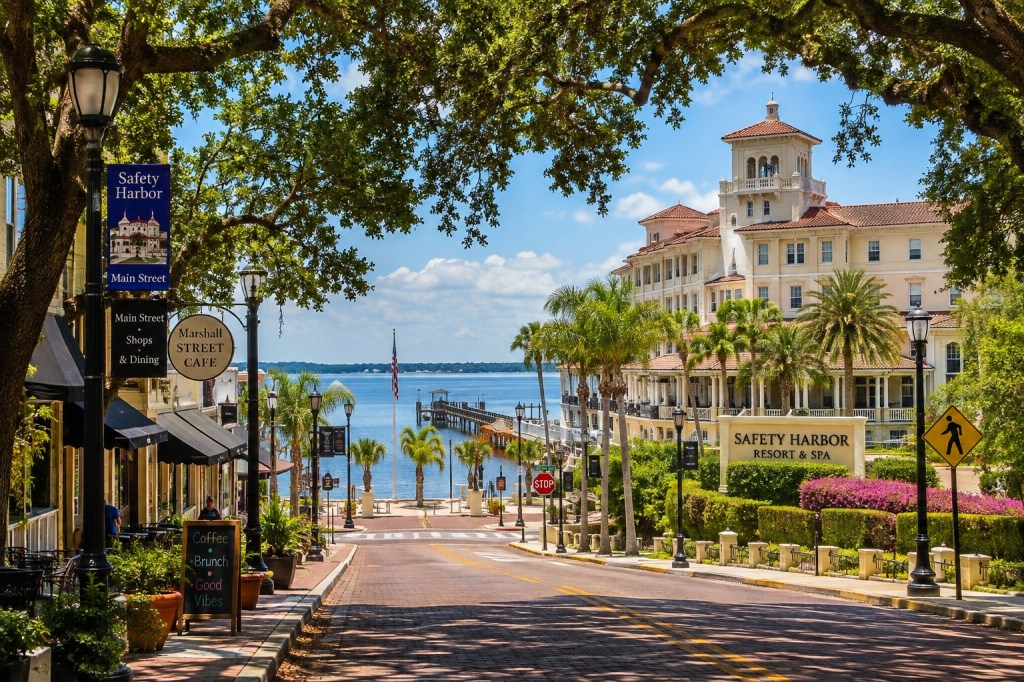
Safety Harbor sits in the middle of one of Florida’s largest metropolitan areas, just a short drive from Clearwater and Tampa. Millions of people live within an hour of it. Major highways, airports, shopping centers and subdivisions are all nearby.
But turn onto Safety Harbor’s Main Street and much of that seems to disappear.
The street slopes gently toward the blue water of Old Tampa Bay. Mature trees shade sidewalks lined with restaurants, cafés, boutiques and small businesses. At the eastern end of downtown stands a grand old Florida institution, the Safety Harbor Resort and Spa. Beyond it are the marina, waterfront park and fishing pier.
It feels less like part of metropolitan Tampa Bay and more like a small town that somehow managed to survive inside it.
For people considering a move to northern Pinellas County, that may be Safety Harbor’s greatest attraction.
A Harbor That Really Was “Safe”
Safety Harbor occupies a sheltered spot on the northwest shore of Old Tampa Bay, rather than directly on the Gulf of Mexico.
According to local tradition, vessels that reached this protected portion of the bay had escaped the dangers associated with pirates and the open Gulf and had reached a “safe harbor.”
Long before Europeans arrived in Florida, Indigenous people lived along the shores of Tampa Bay. The Tocobaga culture flourished in this area for centuries, leaving behind archaeological evidence that remains an important part of Safety Harbor’s story.
One of the most impressive reminders can still be seen at Philippe Park, where a large Indigenous ceremonial mound overlooks the bay.
Spanish explorers reached the region during the 1500s. The area’s natural mineral springs became known as Espiritu Santo Springs — “Springs of the Holy Spirit” — and eventually became intertwined with legends about Spanish explorers and the search for a Fountain of Youth.
The Man Who Brought Grapefruit to Florida
Odet Philippe was a French-born settler whose life has accumulated its own share of legends. What is generally accepted is that Philippe became one of the first permanent non-Indigenous settlers in what is now Pinellas County and established a plantation near present-day Safety Harbor.
He is also widely credited with introducing grapefruit cultivation to Florida.
Today his name lives on in Philippe Park, one of the most beautiful public spaces in northern Pinellas County.
The park occupies a magnificent stretch of shoreline beneath sprawling live oaks. There are picnic areas, trails and views across Old Tampa Bay, but the park is more than a pleasant place to spend an afternoon. Its Indigenous mound and connection to Odet Philippe make it one of those unusual Florida places where several layers of history occupy the same few acres.
The Springs Create a Destination
By the late 19th and early 20th centuries, Americans had become fascinated with mineral springs and health resorts. People traveled considerable distances to “take the waters,” believing naturally occurring mineral water could provide therapeutic benefits. Safety Harbor had exactly what they were looking for.
Visitors once made the trip from Tampa by ferry or traveled from Clearwater by stagecoach to experience the springs. Eventually, a health resort grew around them.
The property evolved through several incarnations, including the Safety Harbor Sanatorium, before becoming the Safety Harbor Spa. Today, the Safety Harbor Resort and Spa remains the unmistakable landmark at the foot of Main Street.
The resort is large — surprisingly so for such a small downtown — but it somehow fits. It is difficult to imagine Safety Harbor without it.
The spa connects modern Safety Harbor to the era when Florida was selling something besides beaches and sunshine. It was also selling the promise of restoration, warm weather, mineral water and escape.
In some ways, Safety Harbor still sells exactly that.
Main Street Is the Heart of Town
If you’ve visited some Florida communities where the historic downtown disappeared decades ago, Safety Harbor can be refreshing, because it still has one.
Main Street isn’t merely a street that happens to have some businesses on it. It functions as the community’s living room. Restaurants put tables outside. People walk their dogs. Residents stop for coffee. Small shops and galleries occupy storefronts.
On event nights, downtown can fill with people walking from one end of Main Street to the other. And because the street terminates at the waterfront, there’s always a sense that the bay is part of downtown.
Safety Harbor has also developed a decidedly artistic and slightly quirky personality. Public art, colorful installations, galleries and unusual local businesses give it a character that feels homegrown rather than manufactured.
A Waterfront Without a Beach
People moving to Florida sometimes assume that “waterfront” and “beach” mean the same thing, but Safety Harbor demonstrates otherwise.
There is no broad Gulf beach at the end of Main Street. Safety Harbor faces Old Tampa Bay, on the eastern side of the Pinellas peninsula, and offers instead a peaceful bayfront.
Waterfront Park provides open green space along the shoreline, along with a nature boardwalk and access to the city’s marina and fishing pier. The city’s parks system encompasses more than 130 acres.
The waterfront is particularly attractive early in the morning. Because Safety Harbor faces generally east across the bay, this is sunrise country rather than sunset country.
And that gives the community a very different feeling from Clearwater Beach, Honeymoon Island or the Gulf shoreline.
Following extensive damage during the 2024 hurricane season, the city’s fishing pier was rebuilt and reopened in August 2026 — restoring one of Safety Harbor’s favorite places to walk out over the water.
Those Magnificent Trees
You can’t really describe Safety Harbor without mentioning the trees. Large live oaks form canopies over portions of the community, creating the kind of shaded streets that many newcomers don’t expect to find in Florida.
One tree in particular has become a local celebrity.
The Baranoff Oak, located near the Safety Harbor Library, is estimated to be hundreds of years old. Its massive trunk and spreading limbs make it a living connection to a Florida that existed long before subdivisions and six-lane highways arrived.
Safety Harbor takes its trees seriously, and that contributes enormously to the community’s appearance. Drive through some of its older neighborhoods and you’ll understand why.
Living in Safety Harbor
Safety Harbor offers an interesting compromise for someone moving to the Tampa Bay area.
Clearwater is nearby. Tampa International Airport is easily accessible. Tampa lies across the bay. St. Petersburg is within reach to the south, and the Gulf beaches are only a drive away.
Yet when you come home, you can be back in a community where people gather on Main Street.
Housing reflects the city’s long history. You’ll find older Florida cottages and bungalows near downtown, established neighborhoods beneath mature trees, mid-century homes, condominiums, townhomes and newer houses. There are also highly desirable properties near or overlooking the bay.
That variety is part of Safety Harbor’s appeal, although buyers should remember that Florida real estate can change significantly from one street to the next.
Flood zones, insurance costs, age of the roof, elevation, evacuation zones and proximity to the water all deserve careful investigation before purchasing any home.
Not Quite Like Its Neighbors
One of the interesting things about northern Pinellas County is how different its communities are despite being only a few miles apart.
Tarpon Springs has its Greek heritage, sponge docks and Anclote River. Palm Harbor offers a largely residential lifestyle with easy access to the Gulf and surrounding communities. Dunedin combines a lively downtown with breweries, baseball, the Pinellas Trail and access to Honeymoon Island. Clearwater is the largest and most urban of the group, with one of America’s best-known beaches just across the Intracoastal Waterway.
And Safety Harbor? Safety Harbor looks east. Its identity is tied to Old Tampa Bay rather than the Gulf of Mexico. It has no famous beach and doesn’t need one.
Instead, it has Main Street. It has the springs. It has the spa. It has Philippe Park and its remarkable history. It has enormous oak trees, neighborhood streets, restaurants, festivals and a waterfront where you can watch the sun come up over Tampa Bay.
Also, it has managed to retain something that is increasingly difficult to find in a fast-growing metropolitan area: A sense that you have arrived somewhere. And for some people thinking about moving to Florida, that might make Safety Harbor exactly what they’ve been looking for.


Leave a comment