
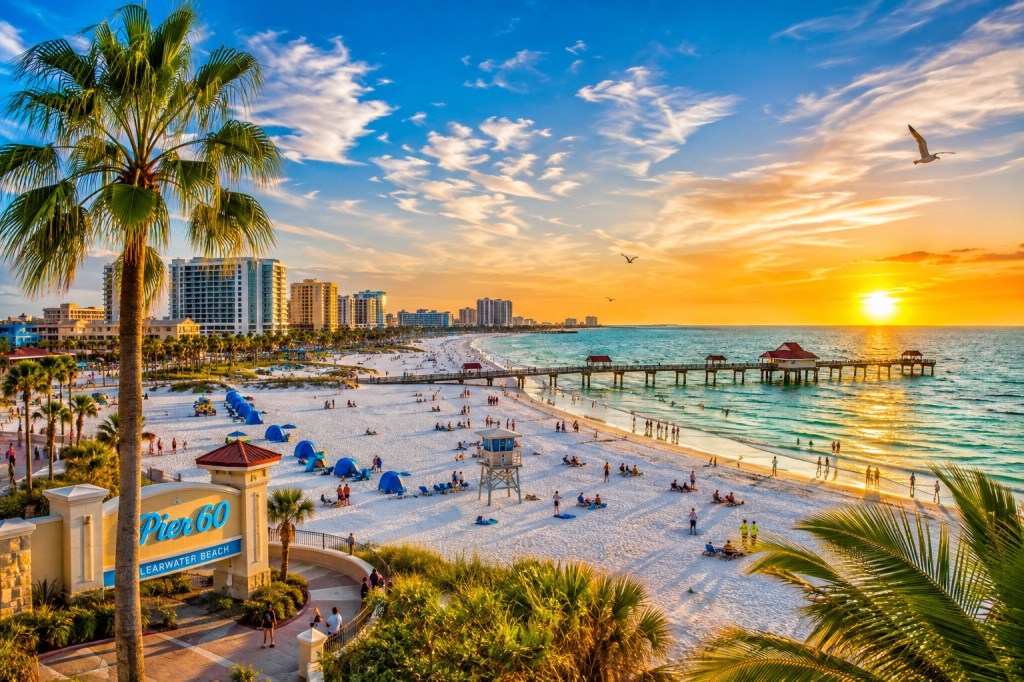
Ask someone who has never lived in Pinellas County what they know about Clearwater, Florida, and chances are the first thing they’ll mention is the beach.
Clearwater Beach, with its broad sweep of pale sand, warm Gulf waters, spectacular sunsets and seemingly endless collection of hotels, restaurants and vacation activities, has transformed Clearwater into an internationally known destination.
But Clearwater is more than a beach.
On the mainland, across Clearwater Harbor, is a city with roots reaching back to Florida’s frontier days, a community shaped by pioneers, railroads, citrus groves, tourism, baseball, postwar growth and, more recently, the unusual distinction of becoming the worldwide spiritual headquarters of the Church of Scientology.
To understand Clearwater today, it helps to start long before there were beach hotels, high-rise condominiums or even a bridge to the Gulf.
Before There Was a Clearwater
The area’s earliest history goes back thousands of years to Indigenous peoples who lived along Florida’s Gulf Coast, taking advantage of its abundant fish and shellfish. European exploration and settlement would eventually change the region dramatically, but the Clearwater of today did not really begin taking shape until the 19th century.
During the Second Seminole War, the U.S. government established Fort Harrison in 1835. Despite its name, it wasn’t primarily a defensive fort. It served as a recuperation center for soldiers and stood on the bluffs in what is now the Harbor Oaks area. The fort was abandoned in 1841, but its name survives in one of Clearwater’s principal streets: Fort Harrison Avenue.
Some of the first permanent settlers arrived around this period. James Stevens, sometimes described as the “father of Clearwater,” was among them. James Parramore McMullen and his brothers also settled in the area during the 1840s, beginning a family presence that would become intertwined with local history.
The small settlement eventually became known as Clear Water Harbor, a name probably inspired by the clear springs that once flowed near the shoreline. Over time, “Clear Water” became “Clearwater,” and “Harbor” disappeared from the official name in 1906.
Clearwater was still a very small place, but that was about to change.
The Railroad Changed Everything
As happened in so many Florida communities, transportation opened the door to growth. The arrival of rail service in the late 19th century connected Clearwater with larger markets and made it easier for agricultural products and people to move in and out of the area.
Citrus became an important part of the local economy, and Florida’s warm winters began attracting visitors from colder northern states, a pattern that remains a defining part of life in Pinellas County to this day.
Until 1912, what is now Pinellas County was part of Hillsborough County. When Pinellas became a separate county, Clearwater became the county seat. Government offices, courts, lawyers and businesses followed, establishing downtown Clearwater as an important civic center.
On May 27, 1915, Clearwater was incorporated as a city, and a year later the city built a bridge to the beach.
Crossing the Water
Back then, the barrier island across the harbor was a very different place. Getting there required a boat. That changed in 1916 when Clearwater constructed its first wooden bridge connecting the mainland with the beach. Suddenly, land that had been relatively isolated became accessible.
Development soon followed. Homes appeared. Small hotels and tourist accommodations opened. Visitors discovered something local residents already knew: the barrier island had an extraordinary beach. From that point on, Clearwater Beach evolved into a major vacation destination.
The Florida Boom Years
Clearwater participated enthusiastically in Florida’s famous real-estate boom of the 1920s. Developers promoted Florida as a tropical paradise, and communities throughout Pinellas County experienced rapid growth. Downtown Clearwater acquired buildings that reflected the prosperity and optimism of the era.
The Capitol Theatre opened in 1921 and remains one of the city’s recognizable historic landmarks. Hotels catered to winter visitors. Businesses expanded. New neighborhoods appeared.
Then came the Florida land bust, followed by the Great Depression, but Clearwater survived both. And baseball, the National Pastime, was about to become part of the city’s identity.
A Baseball Town
Spring training has deep roots in Florida, and Clearwater developed one of the longest-running relationships between a Major League Baseball team and a spring-training community. The Philadelphia Phillies began spring training in Clearwater in 1947 and have returned every year since. The team now plays its spring games at BayCare Ballpark, but the tradition reaches back to an era when spring training was considerably less commercial and players often became familiar faces around town.
The Postwar Transformation
World War II accelerated Florida’s transformation. Thousands of servicemen trained in Florida during the war, and many remembered the climate when deciding where to live afterward.
Clearwater had about 15,000 residents in 1950. Then, the population began climbing rapidly.
Air conditioning made year-round Florida living more practical. Automobiles and improved highways made Pinellas County easier to reach. Retirees arrived from the Northeast and Midwest. Subdivisions replaced woods and citrus groves.
During the ensuing years, Clearwater developed two noticeably different personalities; the city on the mainland, and then, across the water, Clearwater Beach.
Clearwater Beach Becomes a Destination
The beach occupies a barrier island between the Gulf and the Intracoastal Waterway. It is connected to the mainland by the Clearwater Memorial Causeway, whose high bridge provides one of the area’s most dramatic arrival experiences.
Clearwater Beach is highly developed compared with some of Florida’s quieter beach communities. People looking for an isolated stretch of untouched shoreline should look elsewhere. But Clearwater Beach offers something different — a walkable resort community built around the water that offers plenty of restaurants, hotels, dolphin-watching excursions, fishing trips, and sunset cruises.
Sunset at Pier 60
Pier 60 has become Clearwater Beach’s gathering place.
As the sun begins dropping toward the Gulf, visitors gather around the pier and adjacent park. Street performers, musicians and vendors help create a nightly festival atmosphere.
Florida has many beautiful beaches, but Gulf Coast sunsets have a particular advantage: the sun appears to sink directly into the water. On a clear evening, hundreds of people stop what they are doing simply to watch.This remains Clearwater Beach’s simplest attraction.
The Dolphin That Became a Star
Clearwater’s other internationally recognized attraction is not technically on Clearwater Beach but on nearby Island Estates. The Clearwater Marine Aquarium was born in the 1970s in a former water-treatment facility. Its mission involves rescuing, rehabilitating and, whenever possible, releasing injured marine animals.
Then came Winter, the young bottlenose dolphin rescued in 2005 after becoming entangled in a crab-trap line. Her injuries were so severe that she eventually lost her tail. Working with prosthetics specialists, the aquarium developed an artificial tail that helped Winter swim more naturally.
Her story became the inspiration for the 2011 movie Dolphin Tale, filmed largely at the aquarium, with Winter playing herself. Suddenly, a small Clearwater marine-rescue organization had an international celebrity.
Scientology and Downtown Clearwater
It would be difficult to write an honest profile of modern Clearwater without mentioning the Church of Scientology.
Scientology established its spiritual headquarters in Clearwater in 1975 by acquiring the historic Fort Harrison Hotel and the former Clearwater Bank building. Since then, its holdings have expanded dramatically.
The church calls its Clearwater headquarters the Flag Land Base and describes it as Scientology’s international spiritual headquarters. Today its Clearwater operations encompass dozens of buildings and more than two million square feet of property.
The church’s presence is especially visible along Fort Harrison Avenue and in the downtown core, where Scientology-related buildings, offices and facilities occupy a significant amount of property.
That presence has generated controversy over the years, particularly concerning downtown property ownership and redevelopment. At the same time, Scientology has restored and maintained a number of historic downtown buildings and attracts members from around the world to Clearwater.
Scientology is a major institutional and real-estate presence in downtown Clearwater and has played a significant role in shaping what downtown looks and feels like today.
What Is It Like to Live in Clearwater?
Clearwater offers a wide variety of neighborhoods and housing styles. There are older neighborhoods with mature trees and homes dating back many decades. There are condominium communities, waterfront properties, suburban subdivisions and high-rise residences. Some areas feel decidedly urban; others can feel surprisingly quiet.
Living on or near Clearwater Beach is a very different proposition from living several miles inland. Beach and waterfront properties generally command premium prices and come with the realities of coastal living—including storm exposure, flood risk, insurance considerations, salt air and seasonal tourist traffic. Move inland and the equation can change considerably.
The Advantage of Location
Clearwater occupies a central position in Pinellas County. Dunedin is immediately to the north. Largo is to the south. Safety Harbor and Tampa Bay are to the east. The Gulf of Mexico is to the west.
Tampa and Tampa International Airport are readily accessible by the Courtney Campbell Causeway. St. Petersburg is to the south. And some of the Gulf Coast’s best-known beaches are practically in the backyard.
For someone moving from the Northeast, Clearwater can provide something appealing: access to a major metropolitan area without giving up the feeling that the Gulf of Mexico is part of everyday life.
Want to know more about Clearwater? Get in touch with Beth anytime — 727-643-7100 or bethfrederickRE@gmail.com .


Leave a Reply