
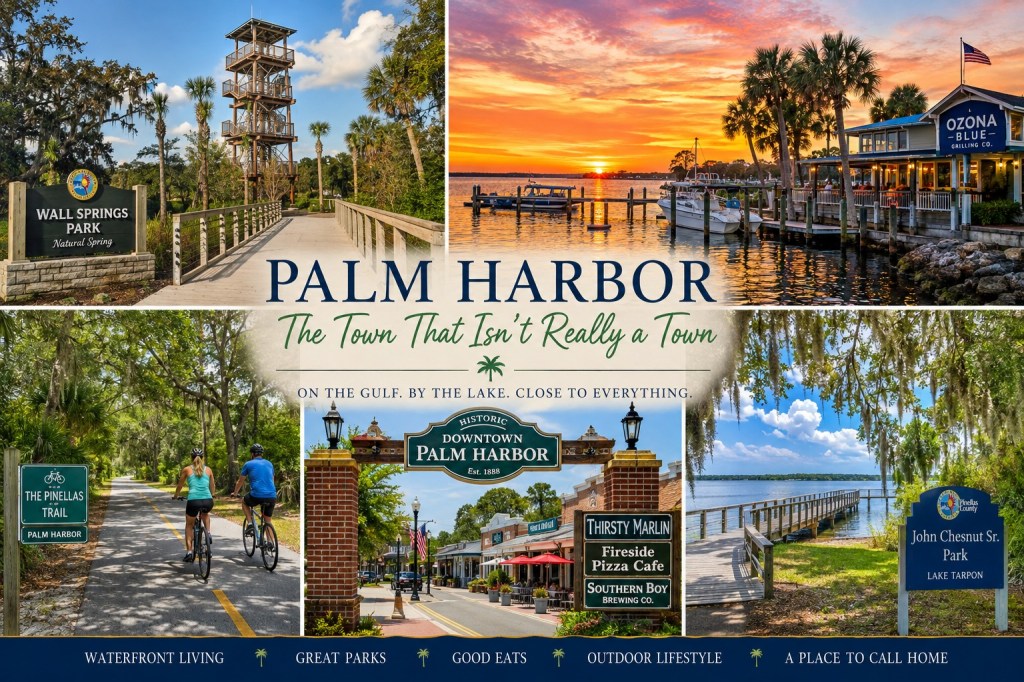
We’ve posted stories recently on this blog about Tarpon Springs, and about Dunedin. But this post is about the community that sandwiched in between those two towns: Palm Harbor.
Both Tarpon Springs and Dunedin have unique characters and personalities. But Palm Harbor is a bit different – it is an unincorporated community that is more a collection of neighborhoods than it is a single town.
Palm Harbor doesn’t have a city hall. Or a mayor. Or a Board of Selectmen. It doesn’t even have a single, unmistakable downtown district that defines the entire community. Rather, it is an unincorporated community of Pinellas County. And most Palm Harbor residents like it that way.
Palm Harbor is less a traditional town and more a collection of neighborhoods, waterfront enclaves, parks, restaurants, and residential communities stretching from St. Joseph Sound on the west to Lake Tarpon on the east.
A Community Between Two Very Different Neighbors
Geographically, Palm Harbor occupies a particularly attractive piece of northern Pinellas County. Tarpon Springs lies immediately to the north, with its famous Sponge Docks, Greek heritage and historic downtown; Dunedin lies just to the south, with its highly walkable Main Street, breweries, shops and restaurants.
Palm Harbor has a small historic downtown centered around Florida Avenue and Nebraska Avenue, with restaurants, bars and local businesses. But downtown Palm Harbor isn’t the center of everyday life in quite the same way downtown Dunedin is. Palm Harbor spreads out, and that’s part of its appeal.
You can live near the Gulf, beside Lake Tarpon, in a golf-course community, in an established older subdivision, or in a newer development. Palm Harbor had 61,366 residents at the 2020 Census, making this “unincorporated community” larger than many incorporated Florida cities.
It Wasn’t Always Called Palm Harbor
Palm Harbor’s history goes back much further than most newcomers realize. Settlers arrived in the area before the Civil War, attracted by Florida’s climate, fishing, farming opportunities and citrus-growing conditions.
Before it was Palm Harbor, it was”Sutherland,” established under that name in 1888. The arrival of the Orange Belt Railway helped connect the little settlement to the rest of Florida. In 1925, Sutherland’s name was changed to Palm Harbor.
The San Marino Hotel became the home of Southern College in 1902. The college remained here until 1922, when it relocated to Lakeland. It eventually became the institution we know today as Florida Southern College.
The railroad is gone, but its roadbed is now the Fred Marquis Pinellas Trail, which passes directly through Palm Harbor and is popular with walkers, runners and cyclists.
Yes, Palm Harbor Has a Downtown—Sort Of
People sometimes say Palm Harbor doesn’t have a downtown, but that’s not quite true. Historic downtown Palm Harbor is a compact district around Florida Avenue with restaurants, pubs, breweries and other small businesses. Pinellas County has made efforts to preserve and strengthen it, and the area was designated a local historic district in 1994.
But don’t expect another Dunedin. Or Tarpon Springs. Palm Harbor’s downtown is smaller, less polished, and considerably less tourist-oriented. In many ways, that works in its favor. Here, the small downtown feels more like a place where locals meet for dinner, rather than a destination for tourists.
Then There’s Ozona
If you really want to understand Palm Harbor, get off U.S. 19 and explore the roads closer to the water.
One of the most interesting places you’ll discover is Ozona, an old waterfront community tucked along St. Joseph Sound. Ozona feels almost like a village within Palm Harbor. There are narrow streets, old homes, newer waterfront houses, marinas and boats. It’s the sort of place where seeing a golf cart headed down the street doesn’t seem unusual.
It also has some excellent casual dining. Ozona Blue Grilling Co. sits at a marina overlooking the water; Ozona Pig has developed a loyal following for Southern-style barbecue.
Ozona is a reminder that the Palm Harbor area existed long before U.S. 19 became northern Pinellas County’s commercial spine.
Crystal Beach: Another Little World
Continue exploring the western side of Palm Harbor and you’ll encounter another distinctive enclave: Crystal Beach, a residential waterfront community with cottages, larger homes, narrow streets and views across St. Joseph Sound.
Crystal Beach provides a small neighborhood waterfront access point where residents can sit near the water and watch another Florida sunset. There are no high-rise beachfront hotels here. No rows of souvenir shops. No sprawling public beach complex. It is much more a neighborhood than a resort.
One of the Best Parks in Pinellas County
Palm Harbor also has an impressive amount of green space, and Wall Springs Park may be the standout example.
The 210-acre county park is built around a natural spring that once served as a bathing area and spa. Today, boardwalks and trails wind through the property, and a 35-foot observation tower provides views toward the Gulf waters. The park connects directly to the Pinellas Trail.
Wall Springs is particularly interesting because it combines two Floridas: There’s the modern recreational Florida of bicycles, playgrounds and walking trails; and then there’s the older Florida of natural springs, mangroves, coastal wetlands and wildlife.
And Don’t Forget Lake Tarpon
Palm Harbor isn’t just about the Gulf side. Drive east across the community and you’ll reach Lake Tarpon, one of Pinellas County’s largest freshwater lakes.
Here is where you will find John Chesnut Sr. Park, a 255-acre county park with nature trails, boardwalks, picnic areas, playgrounds, a dog park, fishing access and a boat ramp. The park borders Lake Tarpon and provides some of the best opportunities in northern Pinellas County to experience natural Florida without driving very far at all. White-tailed deer, wading birds and alligators live here.
Someone living in Palm Harbor can have saltwater a few miles in one direction and a large freshwater lake a few miles in the other.
Palm Harbor Eats Surprisingly Well
Palm Harbor may lack a big restaurant district, but it certainly doesn’t lack restaurants. One of the pleasures of living here is discovering how many good eating places are scattered throughout the community.
Mystic Fish on Tampa Road has long been a popular choice for seafood and a more upscale evening out. The Lucky Dill has become something of a Palm Harbor institution, bringing the oversized sandwiches, bakery cases and comfort food of a New York-style deli to U.S. 19.
Then there are the smaller restaurants and pubs around historic downtown and the waterfront establishments around Ozona.
Golf Is a Pretty Big Deal Here, Too
Palm Harbor is home to one of the best-known golf resorts in Florida. Innisbrook Resort occupies a sprawling property in the northern part of the community. Its Copperhead Course is particularly well known to golf fans as a longtime stop on the PGA Tour.
Even for people who never pick up a golf club, Innisbrook contributes to the character of northern Palm Harbor, where wooded residential areas and golf communities can feel surprisingly removed from the dense commercial development just a short distance away.
The Practical Side of Palm Harbor
Palm Harbor is convenient to just about everything. U.S. 19 provides the primary north-south commercial corridor. Tampa Road provides an important east-west connection, and McMullen Booth Road/East Lake Road offers another route south toward Clearwater and north toward Pasco County.
Clearwater is to the south. Tarpon Springs is immediately north. Dunedin is just minutes away. And Tampa International Airport is reachable without having to live in the middle of Tampa.
For newcomers from the Northeast and Midwest, Palm Harbor can also offer something that many people specifically picture when they imagine moving to Florida: established neighborhoods, palm trees, pools, golf courses, nearby water and the ability to be outdoors almost year-round.
Palm Harbor Isn’t One Thing
Tarpon Springs has the Sponge Docks; Dunedin has Main Street; Clearwater has its beach. Palm Harbor doesn’t have one landmark that defines it; instead, it has “pieces.”
Historic Palm Harbor; Ozona; Crystal Beach; Lake Tarpon; Wall Springs; the Pinellas Trail; Innisbrook; residential neighborhoods stretching from the Gulf side all the way east toward Lake Tarpon.
Two homes with a Palm Harbor mailing address can offer completely different lifestyles. One might be a little bungalow where you can bicycle to the Pinellas Trail and ride a golf cart to dinner, while another might be a waterfront home with a boat behind it.
That’s why you really can’t understand Palm Harbor by simply driving down U.S. 19. Instead, drive down Florida Avenue, or wander through Ozona. Follow the road into Crystal Beach, walk through Wall Springs Park, or explore the neighborhoods around Lake Tarpon.
Want to know more about Palm Harbor, or about moving to this part of Florida? Get in touch with Beth anytime — 727-643-7100 or bethfrederickre@gmail.com .


Leave a Reply