
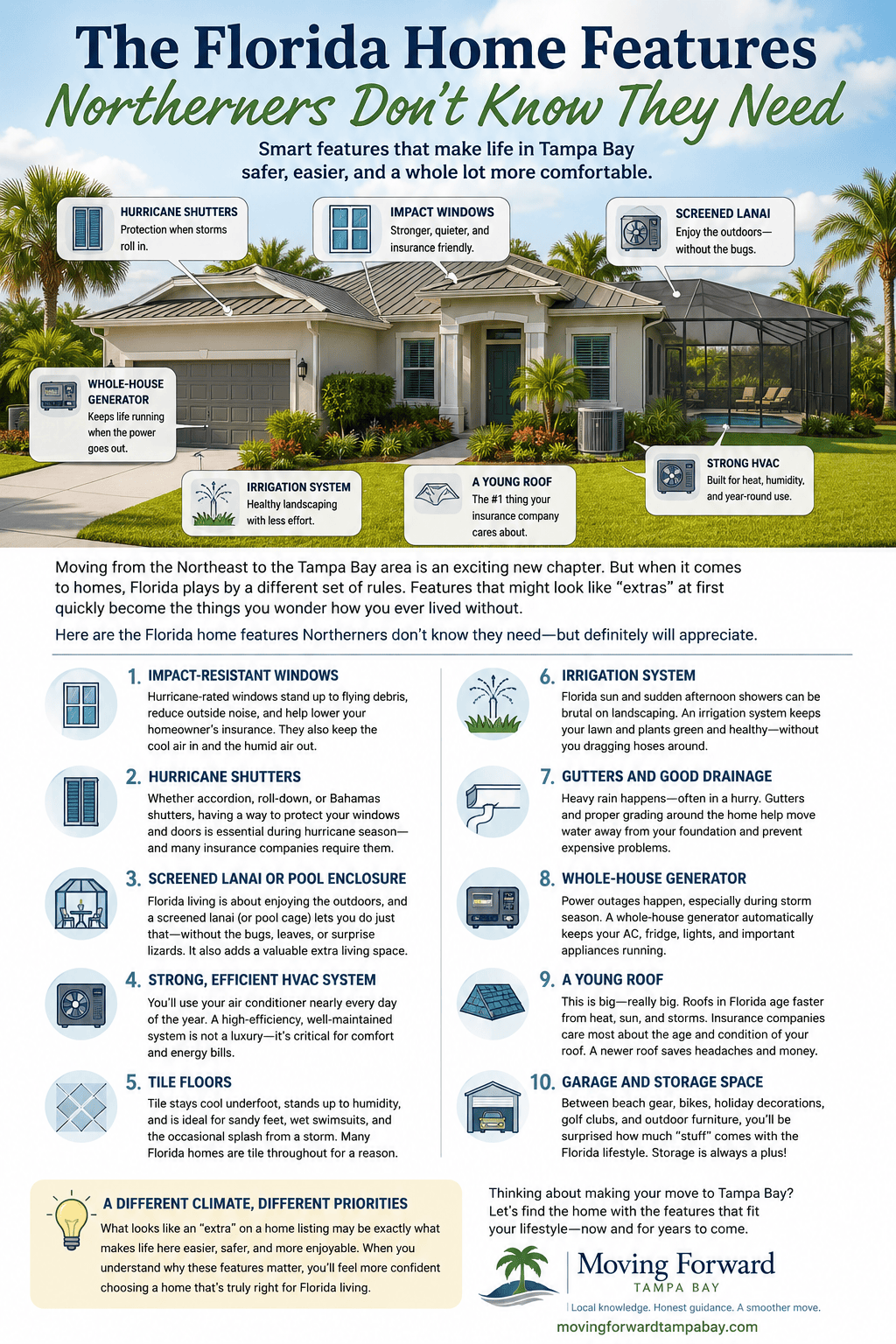
If you’ve spent most of your life in New England, New York, New Jersey, Pennsylvania, or somewhere else where winter is a major consideration, you probably developed a pretty good idea of what makes a house desirable. Items like these:
- A good heating system.
- Insulated windows.
- Maybe a fireplace.
- A basement for storage.
- A driveway that isn’t too difficult to shovel.
Then you move to Florida, where nobody seems particularly interested in the furnace, there probably isn’t a basement, and the swimming pool may be surrounded by what looks like an enormous screen cage. Your Realtor wants to know how old the roof is before you’ve even decided whether you like the kitchen.
Florida houses have evolved to deal with a very different climate, and some features that may initially look like luxuries — or simply seem odd — can make an enormous difference in comfort, maintenance costs and even your ability to insure the house.
Here are some Florida home features Northerners may not realize they need until they live here:
Impact-Resistant Windows
Impact-resistant windows are designed to withstand windborne debris during severe storms and hurricanes. They can eliminate the need to put up plywood or shutters every time a major storm approaches.
But hurricane protection isn’t their only advantage. Impact windows can also reduce outside noise, improve energy efficiency, block ultraviolet rays and help qualify a homeowner for insurance discounts.
If you’ve never lived through a Florida hurricane season, impact windows can seem like an expensive upgrade. After your first serious storm experience, you may view them quite differently.
Hurricane Shutters
Florida homes may have accordion shutters, roll-down shutters, removable aluminum panels or decorative Bahama-style shutters designed for storm protection. Have the homeowner or home inspector show you how they work. You don’t want to discover you’re missing three panels, a dozen bolts and the instructions when a hurricane is three days away.
Storm protection is one of those features that doesn’t make a house prettier during a showing, but it can become one of its most valuable features later.
A Screened Lanai or Pool Enclosure
One of the great pleasures of living in Florida is being able to spend so much time outdoors. Unfortunately, mosquitoes enjoy Florida, too. So do no-see-ums, flies, lizards, frogs and assorted other creatures you may not necessarily want joining you for dinner.
That’s why screened lanais and pool enclosures are so common. They allow you to enjoy the outdoors while dramatically reducing insects, leaves, debris and little creatures. A screened lanai also effectively becomes another living area — a place for morning coffee, afternoon reading, entertaining friends or simply enjoying a warm evening.
A Strong—and Efficient—Air-Conditioning System
In Massachusetts or Pennsylvania, you might occasionally tolerate an aging air conditioner. In Tampa Bay, air conditioning is critical infrastructure.
During much of the year, your AC may operate every day. And it isn’t simply cooling the house. It is also removing moisture from Florida’s humid air. That makes the age, efficiency and condition of the HVAC system especially important when evaluating a home.
Ask when the system was installed. Look at its maintenance history. Find out whether the ductwork has been inspected.
A beautiful kitchen is wonderful. But during a 94-degree July afternoon with tropical humidity, you’re probably going to care a lot more about the air conditioner.
Tile Floors
People arriving from colder states sometimes find Florida’s abundance of tile flooring a little surprising, but there’s a reason for it. Tile stays relatively cool, handles humidity well, and is easy to clean when people track in sand, wet footprints and the occasional aftermath of a tropical downpour. It also makes sense for the Florida lifestyle. Swimming pools, beaches, pets and outdoor living can all be tough on carpeting.
Luxury vinyl plank flooring has also become extremely popular and offers many of the same practical advantages.
That plush wall-to-wall carpeting you loved in Connecticut may not seem quite as appealing after a few Florida summers.
An Irrigation System
Florida weather can alternate between astonishing amounts of rain and stretches when your landscaping desperately needs water. An automatic irrigation system makes maintaining a Florida lawn much easier.
When looking at a home, find out whether the irrigation system works, where its water comes from, and whether watering restrictions apply.
Also, check the sprinkler heads.
One of the traditional Florida homeowner rituals is discovering that a sprinkler intended for the lawn has spent the past six months faithfully watering the driveway.
Gutters and Good Drainage
Northern homeowners worry about snow accumulation; Florida homeowners worry about where several inches of rain are going to go right after a big storm.
Pay attention to drainage around any house you’re considering. Does the property slope away from the foundation? Are there gutters? Where do the downspouts discharge? Does water collect near the garage or lanai?
Look for low areas in the yard. A home can look perfectly dry during a sunny February showing and behave very differently during an August thunderstorm.
Generator Readiness
Florida’s electrical grid is generally reliable, but hurricanes and strong thunderstorms can produce outages. A whole-house standby generator can automatically restore power to essential systems — or potentially the entire house — when utility power goes out. That means refrigeration, lights and, most importantly, air conditioning can continue operating.
A generator isn’t essential for every Florida homeowner, but it’s a feature worth considering, particularly if you expect to remain in the home during hurricane season.
Even if a house doesn’t have one, check whether it already has the electrical equipment necessary to connect a portable generator.
A Young Roof
Here’s something that surprises many newcomers:
You may love the house; your home inspector may say the roof isn’t leaking; and your insurance company may still care very much about how old that roof is.
Florida roofs endure relentless sunshine, high temperatures, heavy rain, tropical storms and occasional hurricanes. Consequently, roof age and condition can become significant considerations when obtaining homeowners insurance.
Before purchasing, determine the roof’s age, material, condition and permit history.
Don’t simply ask: “Does the roof need replacing?”
Also ask: “Will the age of this roof create an insurance problem?”
Those are not necessarily the same question.
More Storage Than You Think You’ll Need
Most Tampa Bay homes don’t have basements. That means everything that once lived downstairs — the Christmas decorations, tools, suitcases, bicycles, old photographs, golf clubs and boxes of things you’re absolutely going to sort through someday — needs somewhere else to go.
Garage storage therefore becomes especially valuable. So do closets, attic spaces, utility rooms, and well-designed storage systems.
Remember that moving to Florida tends to generate an entirely new collection of possessions, so storage matters:
- Beach chairs.
- Umbrellas.
- Coolers.
- Pool equipment.
- Fishing gear.
- Golf equipment.
- Bicycles.
- Outdoor furniture.
The Florida Feature You Can’t See
Two nearly identical houses a few miles apart can have very different exposure to flooding, evacuation requirements, insurance costs and storm surge. That is especially important around Tampa Bay and the Gulf Coast.
Before buying, understand the property’s flood zone, evacuation zone and insurance implications. Don’t assume that being several miles from the beach automatically means flooding isn’t an issue, or that being near the water automatically means it is.
Different Climate, Different Priorities
One of the mistakes newcomers can make is evaluating a Florida home using the same checklist they used back North. Florida plays by different rules:
- That enormous screened pool enclosure suddenly makes sense.
- So does the tile floor.
- And the hurricane shutters.
- And the irrigation system.
- And the Realtor who keeps asking about the roof.
None of this means you need to find a house containing every feature on this list. It simply means understanding why these features exist and deciding which ones matter to you.
The best Florida home isn’t necessarily the one with the fanciest kitchen or the prettiest swimming pool; it’s the one that makes living in Florida comfortable, practical and enjoyable — not just during those gorgeous 75-degree February afternoons, but during the heat, humidity, thunderstorms and hurricane season, too.
That’s something every Northerner should know before calling Florida home.
Thinking about making the move to Tampa Bay? Moving Forward Tampa Bay is here to help you understand the communities, homes and everyday realities of Florida living—before you make the move. Questions? Call Beth at 727-643-7100, or e-mail her at bethfrederickre@gmail.com.


Leave a Reply