
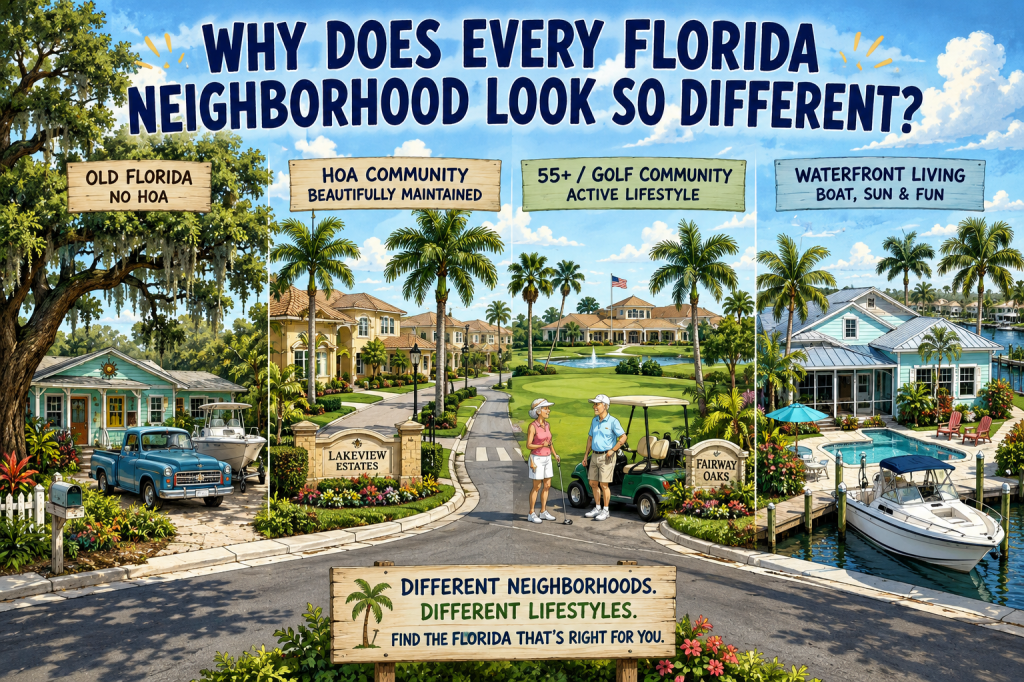
One thing that out-of-state house hunters mention frequently is how different Florida neighborhoods are from one another.
One neighborhood may offer new-style homes, neatly trimmed lawns, and garbage cans that are never left at the curbside; but just a mile down the road you may find 1960-style ranch houses, a boat and trailer parked next to a garage, and 50-year-old oak trees lining the streets.
Drive another mile and you may come upon a gated community complete with its own golf course and clubhouse.
Why is that?
Well, Tampa Bay (and other Florida communities, as well) didn’t all spring from the ground at the same time. Communities were developed in waves over a significant period of time; each wave produced its own style of neighborhoods.
The Older Florida Neighborhood
North Pinellas County’s modern-day neighborhoods are often of the master-planned variety, with lots of amenities. But that doesn’t mean that some of the most interesting and livable neighborhoods in the area are from earlier times. You can find both styles all over Clearwater, Dunedin, Palm Harbor, Tarpon Springs and Safety Harbor.
What’s to like about those earlier communities? Lots are often larger; mature trees are common; architectural styles can be charming. And many of those older homes have been remodeled, expanded, and updated.
And here’s something else that many people find valuable about those older neighborhoods – they often don’t have homeowners associations.
“Wait!” you may say. “Aren’t homeowners associations a GOOD thing?”
The answer is: Some people love ’em; other people hate ’em.
No HOAs can mean freedom when it comes to landscaping, exterior colors, fences, boats, recreational vehicles and other matters. The tradeoff is that your neighbors have the same freedom, too.
The Deed-Restricted Subdivision
As Florida’s population boomed, developers increasingly created subdivisions with rules intended to maintain a consistent appearance. These are commonly called “deed-restricted communities.”
Those restrictions can vary widely. They can limit where you can park, what kind of fence you can have, whether you can keep a boat or trailer at the house, what color you can paint the exterior, or even where you can keep your garbage containers.
For people coming from places where nobody ever told them what color their mailbox could be, this can require some adjustment. But those restrictions can help maintain the appearance of a neighborhood. If you value well-kept lawns, consistent landscaping and some assurance that the property next door won’t suddenly become home to three boats and an RV, deed restrictions can be good things.
Here’s the important thing: Read the rules before you buy, not afterward.
The HOA Community
An HOA—homeowners association—often goes a step beyond basic deed restrictions.
You pay a fee; in return, the association may maintain common areas and provide amenities such as a community swimming pool, clubhouse, fitness center, tennis or pickleball courts, landscaping or gated entrances.
The question isn’t simply, “How much is the HOA?” A better question is: “What am I getting for it?” A community with a higher fee that includes lawn maintenance, recreation facilities and other services may actually work very well for someone who wants a low-maintenance Florida lifestyle. But if you’re fiercely independent about your property, an HOA community might not be for you.
The 55+ Community
Florida has another type of neighborhood that many northern buyers haven’t encountered before: communities specifically designed for residents 55 years of age and older.
Some consist primarily of modest villas or manufactured homes. Others feature expensive single-family houses, golf courses, elaborate clubhouses and packed social calendars.
The appeal isn’t simply age restrictions. It’s lifestyle.
Residents may have access to clubs, exercise classes, card games, dances, swimming, pickleball, golf and organized outings. For someone relocating to Florida without an established circle of friends, that built-in social network can be very attractive. But if you prefer neighborhoods filled with children, bicycles and school buses, it’s probably not the right choice.
The Golf Course Community
Golf and Florida development have gone hand in hand for decades.
Throughout Tampa Bay you’ll find neighborhoods wrapped around fairways, ponds and carefully landscaped greens. Even buyers who don’t play golf may be attracted to them because of the open views and attractive surroundings.
Golf clubs and residential communities can be separate entities, and arrangements vary. Ask about membership requirements, fees and the financial health and future plans of the golf course.
And remember: that beautiful fairway behind the house is not your property.
Waterfront Florida
Some newcomers dream of owning a home on the water. Tampa Bay offers everything from homes along small canals to properties overlooking the Gulf of Mexico.
Waterfront property introduces another set of considerations: flood zones, flood insurance, wind exposure, evacuation zones, seawalls, docks and sometimes significantly higher maintenance costs.
The house may be gorgeous, the view may be spectacular, but make sure you understand everything that comes with it.
The Master-Planned Community
Much of newer Florida has been built on an entirely different model.
Instead of developing one street at a time, developers create entire communities—with subdivisions, walking trails, lakes, playgrounds, clubhouses, pools, schools and commercial areas planned all at the same time.
These communities can offer a highly polished version of Florida living, but they also may come with multiple layers of fees, rules and restrictions. For buyers who want newer construction, modern amenities and a predictable neighborhood appearance, they can be very appealing. But those things may not seem very attractive to someone who dreams of a quirky little Florida bungalow beneath a 70-year-old oak tree.
And Then There’s “Old Florida”
Every so often you’ll turn down a road in Tampa Bay and discover a neighborhood that seems to have escaped all the planning. The streets may twist unpredictably. Houses don’t match. Tropical plants have been growing wherever they pleased for decades. There may be an old cottage next to a new million-dollar home. These little pockets may have tremendous character, and they can be a powerful reminder that Florida wasn’t always gated entrances, identical mailboxes and HOA committees.
Don’t Just Shop for a House
In Florida, you’re not just buying a house; you’re choosing a neighborhood and even a lifestyle. Two houses with similar prices, similar square footage and only a few miles between them can offer completely different versions of Florida living.
One might be in a gated community where the lawn is maintained, the community pool is around the corner, and the HOA has lots of rules you must adhere to; another might sit on a shady street beneath mature live oaks, with no HOA at all; a third might be in a 55+ community where neighbors gather for pickleball every morning; and another might be tucked beside a canal where you can steer your boat toward the Gulf before breakfast.
The question is, which one feels like the Florida life you imagined?
Before you buy, drive through neighborhoods at different times of day. Look at how people maintain their properties. Check the traffic. Read the HOA documents. Find out about flood and evacuation zones. Ask what’s included in the monthly fees. And don’t be afraid to drive a few streets beyond the neighborhood you originally planned to see.
You may discover that the Florida neighborhood you fall in love with looks nothing like the one you expected. That’s part of what makes house hunting here so interesting.
Would you like to know more about the neighborhoods in this part of Florida? Get in touch with Beth anytime — 727-643-7100 or bethfrederickre@gmaail.com .


Leave a comment