
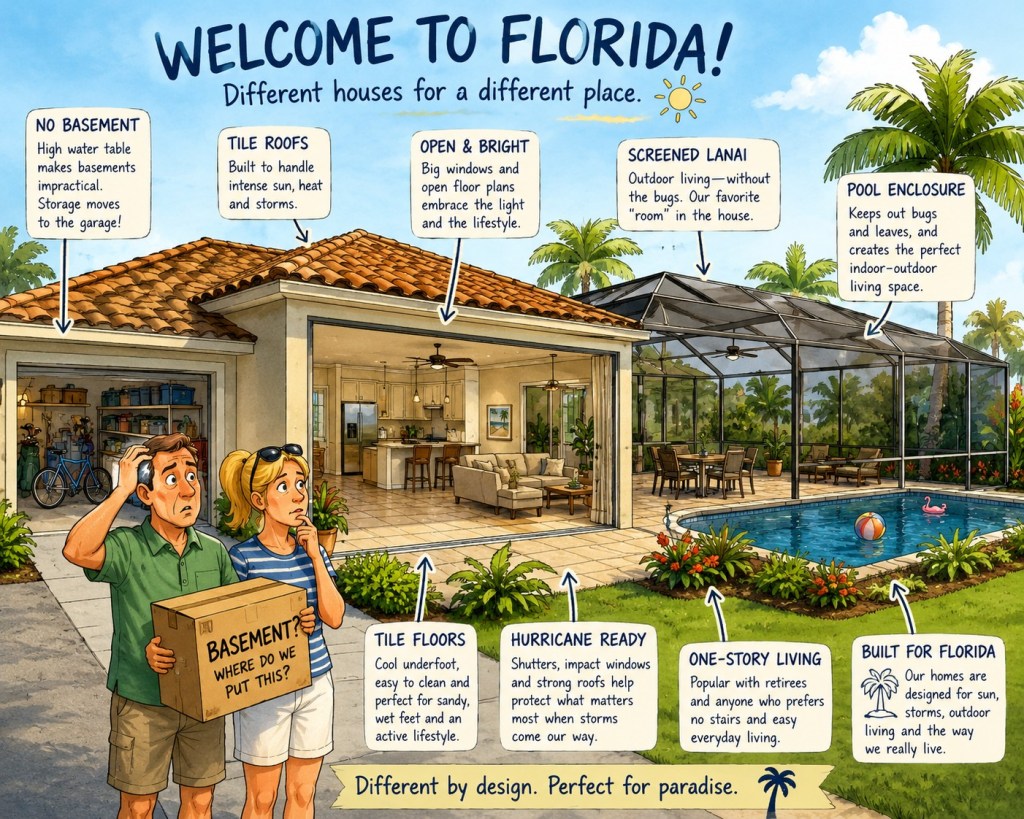
If you’re house-hunting in Florida after spending most of your life in the Northeast or Midwest, it doesn’t take long before you start noticing things. Things like:
- Where’s the basement?
- Why is there tile everywhere?
- Why is the swimming pool inside a giant screen cage?
- And what, exactly, is a lanai?
Florida homes really are different. They evolved in response to a climate, geography and lifestyle that are very different from those in New England, New York, Pennsylvania or the Midwest.
Here are a few things that might surprise you when you begin looking at homes in the Tampa Bay area, and the reasons behind them.
First, About That Missing Basement
For Northeastern homeowners, the basement can be practically another floor of the house. It’s where you put the furnace, water heater, workshop, Christmas decorations and everything else you don’t know what to do with. Some basements become family rooms. Others become offices, workshops, laundry rooms or bedrooms.
Then you move to Florida.
No basement.
The biggest reason is what’s underneath the house. Much of Florida has a relatively high water table, and the state’s geology and drainage conditions generally make below-ground construction impractical and expensive.
There’s also little incentive to build one. Florida homes don’t require the kind of deep foundations associated with severe winter frost and frozen ground. Consequently, the Florida homeowner discovers something important almost immediately:
Storage space matters.
That oversized garage, walk-in closet or backyard storage building that seemed unnecessary when you first toured the house can become surprisingly valuable after you’ve moved in.
Why Is There Tile Everywhere?
Older Northeastern homes traditionally had hardwood floors. Wall-to-wall carpeting became enormously popular later.
Florida developed somewhat different preferences.
Ceramic and porcelain tile make enormous sense in a hot, humid climate. Tile feels cool underfoot, handles moisture well, cleans easily and doesn’t trap sand and dirt the way carpeting can.
And there will be sand. You don’t have to live directly on the beach to discover this.
Florida’s indoor-outdoor lifestyle means people are constantly moving between the house, garage, patio, pool and yard. Hard flooring simply makes that easier.
Luxury vinyl plank flooring has become popular in newer and remodeled Florida homes for many of the same reasons. It provides the appearance of wood without some of the moisture concerns associated with traditional hardwood.
Carpeting hasn’t disappeared, particularly in bedrooms, but an entire Florida home covered in thick carpeting isn’t nearly as common as it once was. Once you’ve lived here awhile, you’ll understand why.
What Exactly Is a Lanai?
A lanai is essentially a covered outdoor living area attached to the house. Think of it as somewhere between a porch and an outdoor room.
The word comes from Hawaii, but Florida enthusiastically adopted both the term and the concept. A typical Tampa Bay lanai might contain a dining table, patio furniture, ceiling fans, television and perhaps an outdoor kitchen or grill nearby. For many Florida homeowners, the lanai becomes one of the most frequently used “rooms” in the house.
During pleasant weather, you may eat breakfast there, read there, entertain friends there or simply sit outside with a cup of coffee. And because it’s covered, you can sometimes continue doing all of that while one of Florida’s afternoon rainstorms passes through.
And What’s With the Giant Screen Around the Pool?
Newcomers sometimes describe it as a cage. Floridians generally call it a pool enclosure or screen enclosure. And once you’ve owned a pool with one, you’ll probably understand the attraction.
Florida has insects. Lots of them. A screened enclosure helps keep mosquitoes, flies and other unwanted visitors away from the pool and outdoor living area. It also keeps out a remarkable amount of debris.
Without screening, leaves, pine needles, insects and assorted vegetation can end up in the pool. Screening substantially reduces the amount of material that gets through. It doesn’t eliminate pool maintenance, but it can certainly make the job easier.
The enclosure also creates something particularly Florida-like: a large indoor-outdoor living space. Open the sliding doors from the house and suddenly the family room, lanai and swimming pool can feel like parts of one continuous space.
Why Are the Roofs So Different?
Look around Tampa Bay and you’ll see plenty of tile roofs, particularly on Mediterranean-style homes, along with asphalt shingles and increasingly popular metal roofing. Florida roofs must withstand intense sunshine, heavy rain, high humidity and potentially hurricane-force winds.
Roof age can also become important when purchasing a Florida home because insurers pay close attention to it. A roof that looks perfectly acceptable to someone relocating from another state may become an important issue when obtaining homeowners insurance. That’s one reason a Florida home purchase shouldn’t be evaluated solely on granite countertops and how much you like the kitchen.
The glamorous stuff is fun, but the roof matters more.
Why Are So Many Florida Homes One Story?
They’re certainly not all one story, particularly as land has become more expensive and builders have sought to put larger houses on smaller lots. But Florida has an enormous number of sprawling ranch-style and single-story homes.
Part of the appeal is practical. Without a basement, the home’s living space spreads outward. Florida’s traditionally abundant land encouraged that type of construction.
There’s also a lifestyle consideration. Single-story homes can be particularly attractive to retirees and people planning to age in place. No stairs means easier accessibility. That can make a well-designed single-story home especially desirable in communities popular with older buyers.
Why Are the Windows Covered With Strange Hardware?
You may be looking at hurricane protection. Depending upon the house, that might mean removable storm panels, accordion shutters, roll-down shutters or impact-resistant windows and doors.
New residents sometimes consider hurricane protection an optional extra, but veteran Floridians tend to look at it differently.
When a storm is approaching and everyone else is standing in line at the hardware store looking for plywood, you’ll appreciate a house where hurricane preparation has already been considered.
Impact-resistant windows can also provide additional benefits, including security, noise reduction and protection from wind-driven debris.
What’s a Florida Room?
A Florida room is generally an enclosed porch or sunroom designed to provide plenty of light and a connection with the outdoors while remaining protected from insects and weather. Some are fully integrated into the home’s air-conditioned living space; others are more like enclosed patios.
Occasionally, you’ll encounter a house where the original screened porch was enclosed sometime during the Nixon administration and has been bravely pretending to be a family room ever since. That’s part of the adventure of looking at older Florida houses.
Why Are the Garages So Important?
Remember the missing basement? Everything has to go somewhere. Bicycles. Tools. Holiday decorations. Beach chairs. Fishing equipment. Golf clubs. Luggage. Hurricane supplies. Coolers. Boxes you haven’t opened since 1997 but remain convinced contain something important.
Suddenly, that two-car garage doesn’t seem quite so large. Many Florida homeowners eventually discover that there’s a difference between a two-car garage and a garage that actually contains two cars.
When comparing homes, don’t just count bedrooms and bathrooms. Think seriously about where you’re going to put your stuff.
Florida Houses Reflect the Florida Lifestyle
None of these features developed by accident. Tile floors make sense because Florida is hot, humid and sandy. Screened lanais make sense because outdoor living is one of the great pleasures of being here — and insects aren’t. Swimming pools make sense because the swimming season can last much of the year.
Single-story homes work well for retirees and people who want to age in place. Hurricane shutters and impact windows exist because tropical weather is part of living on a peninsula surrounded by warm water.
And basements?
Eventually you’ll stop missing yours.
Probably.
Don’t Just Buy a House. Learn How Florida Houses Work.
One of the biggest mistakes someone relocating to Florida can make is evaluating a Florida home exactly the way they evaluated houses back home.
Different things matter here. Roof age matters. Flood zones matter. Insurance matters. Hurricane protection matters. Air conditioning matters. Drainage matters. And location matters — a lot.
The beautiful kitchen that catches your eye in an online listing is certainly worth considering. But so is the 17-year-old roof sitting above it.
That’s one reason spending some time learning about Florida homes — and Florida communities — before buying can pay big dividends.
At Moving Forward Tampa Bay, our goal isn’t simply to show you houses. It’s to help you understand what living here is actually like, particularly if you’re considering a move to the Tampa Bay area. The right Florida home isn’t necessarily the house that looks most like the one you left behind — it may be the one that finally makes you understand why Floridians build houses the way they do.


Leave a comment