
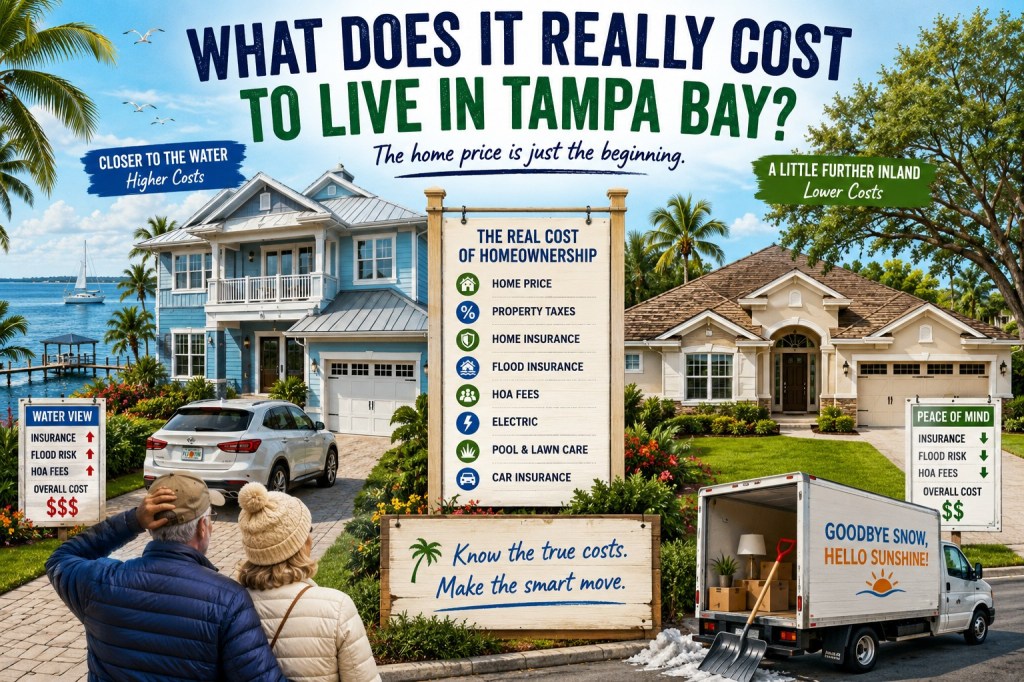
The home price is only part of the equation. Here are some of the costs you should consider before making the move.
Spend a January afternoon shoveling snow in New England or scraping ice from a windshield in upstate New York and moving to Tampa Bay can seem very appealing. Florida may be warmer and sunnier, but is it actually cheaper?
The answer: Sometimes. Florida has its own set of expenses, and some of them can surprise newcomers. If you’re thinking about moving here, don’t ask, “How much house can I afford?” Instead, ask this:
“What will it actually cost me to live there?”
Start With the House
Housing will be your biggest expense, and Tampa Bay isn’t the bargain it was 15 or 20 years ago. Prices vary depending on where you look. A waterfront home in Clearwater or Dunedin is a very different proposition from a modest house several miles inland.
Even within the same community, moving a few neighborhoods away from the Gulf can make a substantial difference. That’s why it’s important not to become fixated on living as close to the beach as possible. In North Pinellas County, Palm Harbor, Tarpon Springs, Dunedin, Safety Harbor and Clearwater can put you within easy reach of the Gulf without requiring you to live directly on it. Living a little farther inland may save you money in more ways than one.
Property Taxes: Don’t Rely on the Seller’s Tax Bill
The property tax shown on a house you’re considering may not be a good indication of what you’ll pay after buying it. Florida’s homestead protections can limit increases in the assessed value of an owner’s primary residence. Someone who has owned a home for many years may therefore have a taxable value considerably below its current market value.
When the property changes hands, its assessed value can re-set based on current rules and valuation. So, don’t simply look at what the current owner paid last year and assume that’s what you’ll pay. Ask for an estimate based on your purchase price and circumstances.
Homeowners Insurance Can Be the Big Surprise
For many people moving to Florida, homeowners insurance can produce a case of sticker shock. Florida’s insurance market has been challenging in recent years, and premiums depend on far more than the value of the house.
Insurers may care about the age and condition of the roof, construction type, hurricane protection, electrical and plumbing systems, previous claims and other characteristics of the property. The result: Two similarly priced houses can have very different insurance costs.
A less glamorous house with a newer roof, updated systems and good storm protection may turn out to be a better financial choice than the prettier house down the street.
Before committing to a purchase, find out what the cost will be to insure it.
Then There’s Flood Insurance
A house doesn’t have to sit directly on the beach to have flood exposure, and flood risk can vary significantly within a relatively small area. That’s particularly important around Tampa Bay, where flooding potential can depend on the Gulf of Mexico, Tampa Bay itself, rivers, lakes, canals, and plenty of low-lying land.
Before buying, ask about the property’s flood zone, and whether a lender is going to require flood insurance. Even if it isn’t required, you still may want to carry it.
Don’t Forget the HOA
Some Tampa Bay neighborhoods have no homeowners associations at all; Others may have modest and relaxed associations, or heavily regulated organizations that charge hefty fees.
Monthly condo fees may cover services you’d otherwise pay separately, but buyers should understand exactly what’s included—and investigate the financial condition of the association and the possibility of assessments.
HOAs or condo associations aren’t necessarily bad; they can offer lawn maintenance, exterior upkeep, a swimming pool, fitness facilities or other amenities. But be sure to figure in the HOA fees when you compare homes you might want to buy. A $325,000 home with a sizable monthly HOA fee might cost more to own than a $350,000 home without one.
Your Electric Bill May Replace Your Heating Bill
Florida summers are hot and humid, and air conditioning isn’t optional. During the warmest months, it may run much of the day. Your electric costs will depend on the size and efficiency of your home, insulation, windows, thermostat settings and the age and efficiency of the HVAC system.
When you’re house hunting, ask to see recent utility bills. And pay attention to the age and condition of the AC. Replacing an aging HVAC system can be expensive.
Pools Aren’t Free
Swimming pools are great to have. But… they require cleaning, chemicals, electricity, equipment maintenance and occasional repairs. If you hire someone to handle routine pool service, that’s another monthly expense.
Also, Florida vegetation grows enthusiastically, so chances are you will be mowing, trimming, fertilizing, weeding, and maintaining irrigation, or paying somebody else to do it.
Car Insurance
Automobile insurance can be a significant expense in Florida. Your actual premium will depend on your driving record, number of vehicles, coverage, location and many other factors. Make sure to get quotes rather than simply assuming your current premium will follow you south.
Now, some GOOD news
There are financial advantages to Florida living. Most notably, Florida does not impose a state individual income tax, and that can represent a major financial benefit when compared to what you may have been paying up north.
And here are a few other advantages: There are no snow tires to buy, no driveways to plow, no wood stoves to feed, no heating oil to buy, and no oil furnaces to maintain. Plus, Florida’s homestead provisions can provide significant benefits to permanent residents who own and occupy their homes as their primary residence.
The Real Question Isn’t “Is Tampa Bay Cheap?”
The better question is whether the total cost of living here makes sense for you.
When comparing Tampa Bay with where you live now, put everything on the table:
- • Housing
- • Property taxes
- • Homeowners insurance
- • Flood insurance
- • HOA or condo fees
- • Electricity
- • Lawn and pool maintenance
- • Automobile insurance
- • Transportation
- • State income taxes
Maybe the house costs a little more than you expected. But you no longer have a state income tax bill. Maybe insurance costs more, but heating costs less. Perhaps living ten minutes farther inland saves enough on the house and insurance to make the entire move work better.
Thinking about relocating to the Tampa Bay area? Moving Forward Tampa Bay can help you explore the communities, lifestyle and practical considerations that go into making Florida home. Do you have questions? Call me, Beth Frederick, anytime at 727-643-7100. Or e-mail me at bethfrederickre@gmail.com.


Leave a comment