For many people thinking about moving to Florida, the wish list starts with three words:
Near the beach.
It’s understandable. If you’ve spent much of your life in Maine, Massachusetts, New York, Pennsylvania or somewhere else where a trip to the beach is a special summer occasion, the idea of living a few blocks from the Gulf of Mexico can sound like the ultimate Florida dream.
But before you tell your Realtor, “I want to be as close to the beach as possible,” there is another question worth asking:
How close do you really need to be?
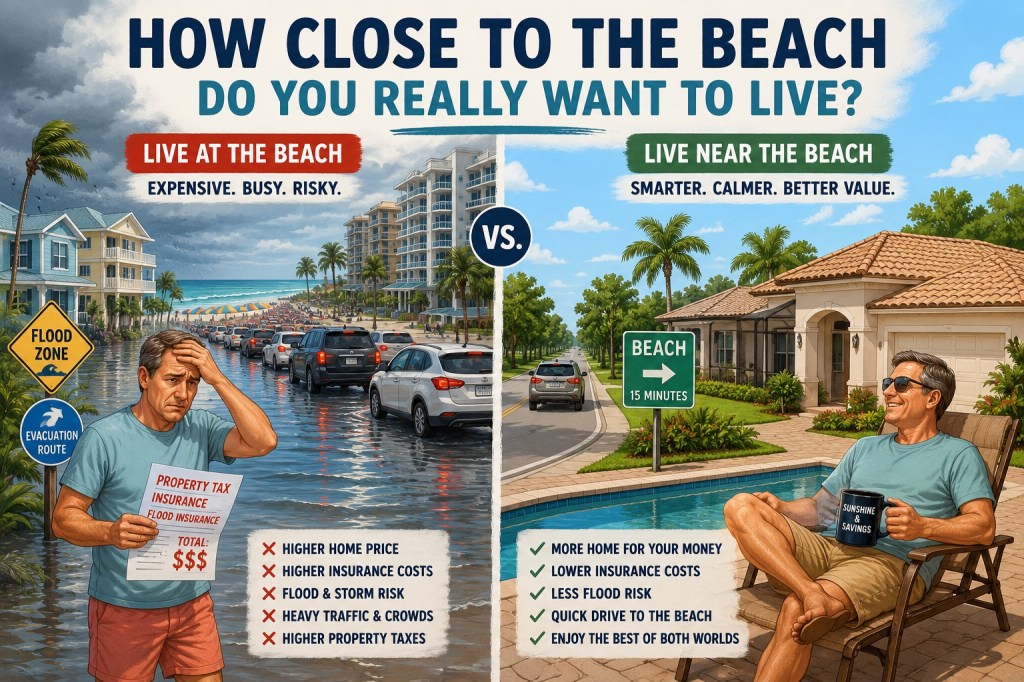
Because in the Tampa Bay area — and particularly in North Pinellas County — you can enjoy the beaches without actually living at the beach. And there can be some significant advantages to putting a few miles between your house and the Gulf.
The Beach May Be Closer Than You Think
One of the things newcomers sometimes don’t appreciate is just how accessible the water is from much of Pinellas County.
Live in Palm Harbor, Dunedin, Clearwater or Tarpon Springs and a trip to the Gulf can be an easy part of the day rather than an expedition requiring advance planning.
You can spend the morning at Honeymoon Island, take an afternoon walk along the Gulf, catch a sunset at the beach and still go home to a house several miles inland.
That distinction matters.
If what you really want is access to the beach, you have far more choices than if you insist upon living at the beach.
And those choices can save you considerable money and eliminate some of the complications that come with coastal living.
Waterfront Comes at a Price
There’s a reason real estate advertisements emphasize words such as “waterfront,” “Gulf view” and “steps from the beach.”
People will pay for them.
The closer you get to desirable waterfront locations, the more likely you are to encounter a substantial premium for the land beneath the house. Sometimes you’re paying considerably more for a property that might cost much less just a few miles inland.
That doesn’t make waterfront property a bad choice. If watching the sun set over the Gulf from your own backyard has been your lifelong dream and your budget comfortably allows it, that’s a perfectly legitimate priority.
But if you’re relocating to Florida for retirement, the better question may be:
What else could that money buy?
A larger home? A newer home? A swimming pool? A better neighborhood for your particular lifestyle? More money left in your retirement account?
For some buyers, living 15 or 20 minutes from the water instead of two minutes from it can change the equation considerably.
Then There’s Flooding
This is the part of coastal Florida living that shouldn’t be romanticized.
Living close to the Gulf can mean greater exposure to storm surge and flooding. But distance from the water isn’t the only thing that matters. Elevation, the property’s specific flood zone and even differences from one street to another can be important.
That’s why anyone considering a Florida home should investigate the flood situation for the specific property, not simply assume that an entire community is either “safe” or “in a flood zone.”
The same applies to insurance.
Flood insurance and homeowners insurance can become important pieces of the affordability calculation. A house that appears to fit comfortably within your budget based on its purchase price can look different once insurance, taxes, HOA or condo fees and other recurring expenses are added.
For someone moving from another state, those costs deserve attention before falling in love with the house.
That doesn’t mean you shouldn’t live there.
It means you should understand what living there involves.
When you’re shopping for a house, don’t just ask, “How far is the beach?”
Ask, “What evacuation zone is this in?”
Some people love that energy.
Others discover they’d rather visit it — and then go home.
That’s one of the attractions of communities such as Palm Harbor, Dunedin, Safety Harbor and Tarpon Springs. You can enjoy restaurants, parks, trails, community events and distinctly Florida surroundings while keeping the Gulf within easy driving distance.
You don’t necessarily have to choose between “Florida lifestyle” and “inland living.”
Here, they frequently overlap.
-0-
Did this post raise questions in your mind? Want to discuss further? Get in touch and we’ll chat — 727-643-7100 or bethfrederickRE@gmail.com.
Beth


Leave a comment